Much of Ennis sits on soft alluvial clays and silts deposited by the River Fergus, where natural moisture content often exceeds the liquid limit near the surface. This creates real challenges for foundations: low bearing capacity, excessive settlement, and sensitivity to disturbance make conventional shallow footings a gamble. Stone column design offers a proven ground improvement path. By installing compacted gravel columns through vibro-displacement, we reinforce the weak matrix, creating a composite ground mass that drains excess pore pressure and carries structural loads. The CPT test gives us the continuous profile needed to size columns correctly, mapping undrained shear strength every 10 cm before a single rig moves on site. For projects near the Fergus floodplain—where peat lenses appear without warning—we often pair stone column design with slope stability assessments, especially when modified ground interacts with existing riverbank geometry.
Stone columns in Ennis alluvium cut settlement by up to 70% compared to untreated ground—and they accelerate consolidation drainage, so your floor slab isn't waiting months for pore pressure to dissipate.
Methodology applied in Ennis
Critical ground factors in Ennis
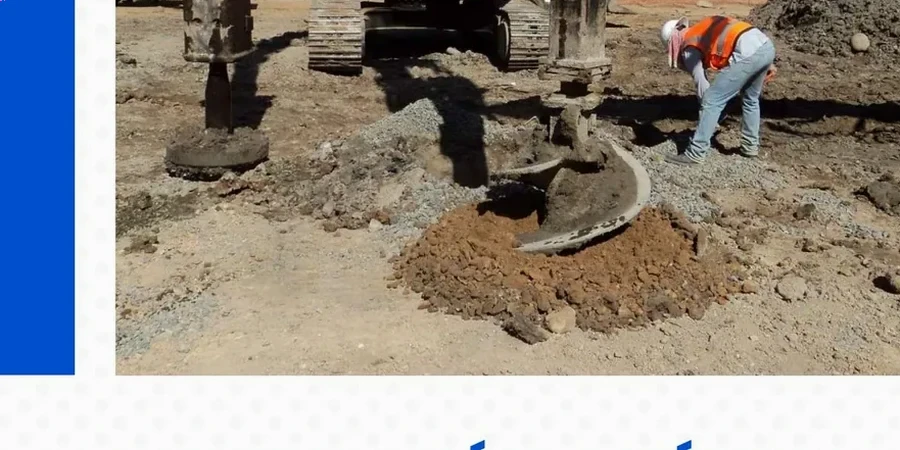
We use a depth vibrator rig with a 180 kW power pack and a 300 mm diameter poker, capable of penetrating the stiff crust that often overlies the soft Fergus alluvium. The biggest risk in Ennis isn't the column installation itself—it's missing a thin peat lens during the site investigation. Peat doesn't compact; it displaces laterally under vibration, and a stone column built through it won't develop the confinement needed for load transfer. That's why our design protocol demands at least one CPT sounding per 200 m² in areas mapped as alluvial floodplain, with supplementary boreholes to sample any organic horizons. We also watch the groundwater closely: the water table in central Ennis sits within 1–2 m of the surface most of the year, and wet-process vibro-replacement must manage spoil disposal and silt-laden water without clogging adjacent drains. Every design includes a contingency for column lengthening if field conditions prove softer than the desk study suggested.
Our services
Our stone column design workflow in Ennis covers the full chain from feasibility assessment to post-installation sign-off. Each deliverable is tailored to the specific ground profile encountered on site, not a generic template.
Feasibility and Preliminary Design
We review existing site data, run settlement analyses on untreated ground, and determine whether stone columns are technically suitable for your Ennis site. The report includes a preliminary column layout, depth estimate, and cost-range projection before any rig is mobilized.
Detailed Design Package
Full design calculations in accordance with Eurocode 7, including column spacing, diameter, stone specification, and acceptance criteria. The package contains construction drawings, a method statement for the installer, and a test plan for quality control.
Installation Supervision and Verification
We carry out an experienced geotechnical engineer on site during column installation to monitor penetration rate, amperage, and stone consumption per lift. Post-installation zone load testing and settlement monitoring confirm that the design intent has been met.
Questions and answers
What does stone column design cost for a typical Ennis residential site?
For a single-dwelling residential site in Ennis, the stone column design package—covering feasibility analysis, detailed design calculations, and construction drawings—typically ranges from €1,240 to €4,930 depending on column depth, number of columns, and verification testing requirements. Sites with challenging ground conditions or deeper treatment depths will be at the upper end of that range.
How do you decide between stone columns and vibrocompaction in Ennis soils?
It comes down to the fines content. Stone columns work in cohesive soils—the Fergus alluvium with its high silt and clay fraction is a classic candidate. Vibrocompaction needs granular soils with less than 10–15% passing the #200 sieve, which you don't typically find in central Ennis. We run a grain size analysis early in the design phase to confirm the choice.
How deep do stone columns need to go in Ennis?
Column depth is dictated by the thickness of the compressible layer and the proximity of competent bearing strata. In Ennis, we often encounter 4 to 8 metres of soft alluvium overlying glacial till or limestone bedrock. Columns are designed to fully penetrate the soft layer and bear on the firmer material below. CPT refusal or borehole log data pinpoints the exact termination depth for each location.
What acceptance tests do you require for stone columns?
We specify zone load tests on a group of at least three columns using a rigid plate that spans the column heads. The load-settlement curve must meet the design modulus, and we typically test a minimum of one location per 300 m² of treated area. Additional column integrity checks by probing or dynamic cone penetration can be included where access allows.