Ennis grew around its medieval core, but the expansion onto the River Fergus floodplain and surrounding drumlin country introduced serious geotechnical variation. The town’s elevation hovers near 3 m OD in the centre, with water‑bearing alluvium barely a metre below street level on the causeway side. The shift from limestone till on the ridges to compressible silts in the low areas means that a raft or mat foundation often becomes the safest answer. When a client near the old gaol site needed to spread column loads over an area with 70 kPa bearing capacity, the team combined a site‑specific CPT test with a deep review of the drainage history before locking in the mat geometry. That type of integration is what makes a raft work where individual footings would tilt within months.
A well‑designed raft doesn’t eliminate settlement — it makes settlement uniform enough that the structure doesn’t notice.
Methodology applied in Ennis
Working video
Critical ground factors in Ennis
I.S. EN 1997‑1 (Eurocode 7) requires that the design of any spread foundation accounts for the stiffness profile of the supporting ground, not just the ultimate bearing capacity. In Ennis, where the water table sits within 1–2 m of formation level on many brownfield plots, the risk of undrained behaviour under rapid loading is real. A mat foundation that hasn’t been checked for short‑term pore‑pressure build‑up can expertise edge‑heave and centre‑punching during the first wet winter after construction. The technical team runs coupled consolidation analyses for the upper two metres of the soil column and specifies a minimum construction surcharge period when the site history shows recent filling. Ignoring that step can turn a €150 000 ground‑floor slab into a long‑term levelling problem.
Our services
The raft design package for Ennis projects typically includes three interdependent stages — from ground characterisation through to reinforcement detailing.
Ground model and parameter selection
Cone penetration testing, borehole sampling, and lab classification are combined to build a 3D stiffness map. The output defines the modulus of subgrade reaction zone by zone, which feeds directly into the mat design.
Raft geometry and reinforcement design
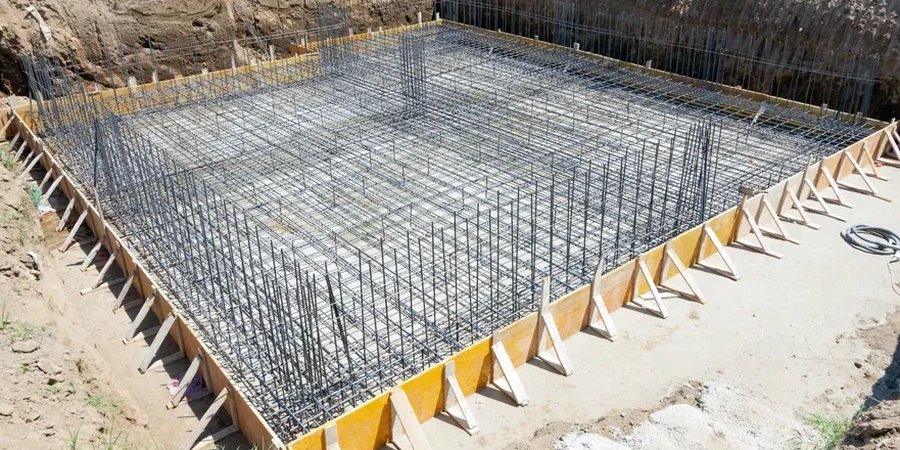
Finite‑element modelling of the slab‑soil interaction, including ribbed, flat, and cellular raft options. Reinforcement is detailed for bending, punching shear at columns, and edge restraint, with full bar‑bending schedules.
Construction‑stage monitoring plan
Settlement markers, piezometers, and a defined surcharge‑holding period are specified to verify that the raft is performing within the predicted envelope before the superstructure loads are applied.
Questions and answers
What does a raft foundation design cost for a typical Ennis residential site?
For a single‑dwelling mat on a prepared level site, the design package — covering ground investigation interpretation, finite‑element analysis, and reinforcement detailing — generally falls between €880 and €4,080 depending on footprint size, number of stiffening ribs, and the complexity of the ground model required.
When is a raft foundation better than individual footings in Ennis?
A raft becomes the preferred option when the bearing soil is soft or highly variable across the building footprint, when the water table is close to the surface, or when differential settlement between isolated footings would exceed the structural tolerance. In the Fergus floodplain corridor, these conditions are common enough that a mat is often the default starting point.
How is the water table accounted for in the design?
The team reviews long‑term groundwater records from the EPA and local well data, then models the worst‑case seasonal high. The raft is designed for the buoyancy forces and reduced effective stress that come with a water table at or near the underside of the slab, and a drainage layer with a positive fall is specified wherever the site geometry allows.
Can a raft foundation be designed for an extension to an existing building?
Yes. The design must consider the differential movement between the new mat and the existing foundation system. The team typically models both structures together and introduces a movement joint or a transition zone of deepened beams to manage the stiffness contrast.