The design of any structure in Ennis, from a housing development off the Kilrush Road to a commercial building in the town centre, must account for the ground conditions beneath. The triaxial test delivers the critical shear strength parameters—effective cohesion and friction angle—that are mandatory under Eurocode 7 (IS EN 1997-2:2007) for foundation calculations. The soils across Ennis vary considerably: the River Fergus floodplain carries soft alluvial silts, while the drumlin hills to the northeast present stiffer boulder clays. A triaxial test on an undisturbed sample from each stratum provides the drained and undrained strength data needed to size footings, design retaining structures or assess slope stability. Our laboratory runs consolidated-undrained and consolidated-drained stages on Shelby tube samples recovered from site investigation boreholes, giving you the effective stress parameters that control long-term settlement and bearing capacity failure.
An effective stress triaxial test on a high-quality sample removes the guesswork from foundation bearing capacity—what remains is reliable soil strength for your structural calculations.
Methodology applied in Ennis
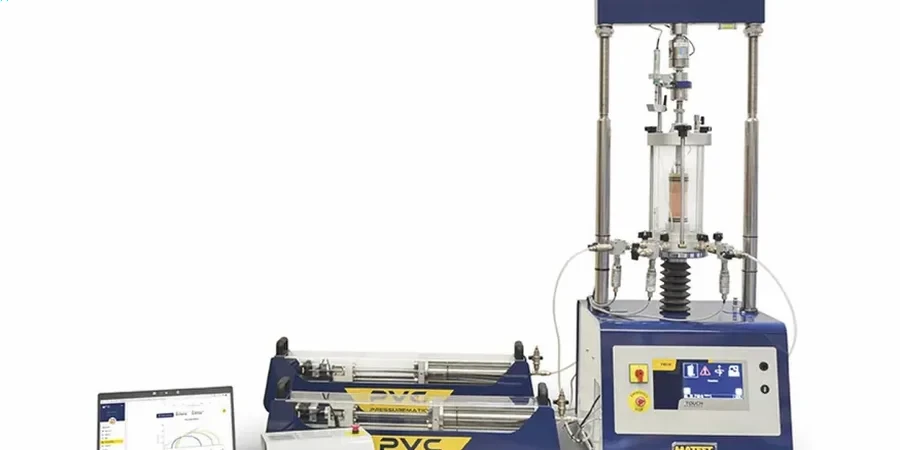
Critical ground factors in Ennis
The glacial and post-glacial geology of Ennis means you can encounter a metre of soft organic silt above a stiff boulder clay, or a lens of saturated sand within the till. If the triaxial test is skipped and bearing capacity is estimated from SPT N-values alone, the foundation may be undersized for the weak horizon. The till itself contains cobbles of Carboniferous limestone; sample disturbance during boring can reduce the measured undrained strength by twenty per cent or more if the tube is hammered rather than pushed. Our site investigation crew uses thin-walled sampler heads and controlled drilling rates to preserve the in-situ fabric. In the lab, we consolidate each specimen to the estimated field effective stress before shearing, so the friction angle you receive reflects the true behaviour of the Ennis ground, not a remoulded approximation. On sites near the Fergus where the water table sits within two metres of the surface, the effective stress path from the triaxial test also highlights any tendency toward contractive behaviour that could trigger a bearing failure.
Our services
Triaxial testing sits within a broader geotechnical investigation workflow. For a complete ground model in Ennis, we pair the lab programme with field exploration and supplementary testing.
Triaxial Test Programme
A three-specimen set per stratum, consolidated to in-situ stress and sheared undrained or drained. You receive effective cohesion, friction angle, stress-strain curves and pore pressure response. Suitable for foundation design, embankment stability and excavation support on the glacial soils of County Clare.
Site Investigation & Sampling
Borehole drilling with Shelby tube recovery across Ennis town and the surrounding drumlin belt. We log the strata, measure the groundwater level and ship the samples to the triaxial lab under controlled conditions so that disturbance is minimised and the test results are representative.
Questions and answers
What does a triaxial test cost for a single soil layer in Ennis?
A full set of three specimens for a single stratum, including consolidation and undrained shear with pore pressure measurement, runs between €1.560 and €2.680 depending on the soil type and whether drained stages are also required. The price covers sampling guidance, specimen preparation, saturation, consolidation, shearing and the final report with Mohr-Coulomb parameters.
Which triaxial stage do I need for an embankment on Ennis alluvium?
For an embankment over soft alluvium, a consolidated-undrained (CU) test with pore pressure measurement is the minimum. It gives you the undrained shear strength of the foundation soil at its current water content and will indicate whether the loading generates excess pore pressure that could lead to a delayed failure. If the embankment is permanent, we also recommend a drained (CD) stage on a parallel set to obtain the effective stress friction angle for long-term stability analysis.
How long does the triaxial laboratory programme take?
A standard three-specimen consolidated-undrained set takes seven to ten working days from sample receipt, assuming the specimens saturate within a reasonable time. Silts from the Ennis area usually reach a B-value above 0.95 within three to five days under back pressure. Drained stages add roughly a week because the shear rate must be slow enough to prevent pore pressure build-up. We always confirm the timeline after seeing the samples.
Can triaxial test results help if my Ennis site has a high water table?
Yes, and in fact they are essential. With the water table often within one to two metres of ground level near the River Fergus, the effective stress state governs bearing capacity. The triaxial test measures the pore pressure response during shear, so we can identify whether the soil contracts and builds up pressure, or dilates and gains strength. That data feeds directly into the drained and undrained parameters used in the foundation calculation, removing the risk of an unsafe design based on presumed values. More info.