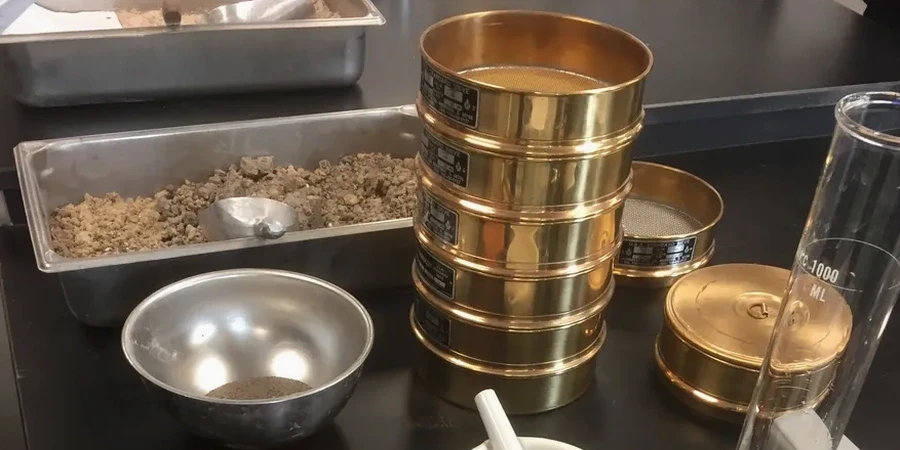
A set of 200 mm diameter brass sieves, a mechanical shaker running for ten minutes, and a sedimentation cylinder in a constant-temperature bath. That is what a proper grain size analysis looks like on the bench, and it is what we run for every project in Ennis. The town sits on a mix of limestone-derived glacial till and soft alluvial silts along the River Fergus floodplain. These two materials behave very differently under load. A full particle size distribution curve, combining dry sieving and hydrometer analysis, splits the coarse fraction from the fines and tells us exactly what we are dealing with before a single cubic metre of concrete is poured. In Ennis, where floodplain clays can hold 60% silt and the till can carry cobbles up to 100 mm, skipping the hydrometer step is a mistake we see in old site reports too often.
A hydrometer curve that stops at 10% clay when the sample actually has 25% clay changes the soil classification, the permeability estimate, and the foundation recommendation.
Methodology applied in Ennis
Critical ground factors in Ennis
In Ennis, we frequently see borehole logs that classify a soil as 'sandy gravel' based on a visual field description, when a full PSD later reveals 18% fines. That difference changes the drainage path, the compaction specification, and the risk of frost heave. The most common pitfall is running a dry sieve analysis on a sample that needed wet sieving first. Clay coatings on gravel particles stay intact, the fines stay stuck to the coarse fraction, and the reported sand content is artificially low. Another trap is hydrometer readings taken without temperature correction in an unheated site lab in February. The River Fergus alluvium, with its high silt content, also tends to flocculate if the dispersant dose is too low, giving a false clay reading. We run a blank hydrometer cylinder alongside every batch to catch this. Getting the PSD wrong does not just misclassify the soil; it feeds incorrect permeability values into dewatering designs and leads to filter fabrics that clog within six months.
Our services
Our Ennis laboratory provides a full suite of particle size distribution testing, from field sampling to final engineering report. Each service below is calibrated to the soil types found across County Clare.
Combined Sieve and Hydrometer (Full PSD)
Complete particle size distribution from 75 mm down to 0.001 mm. Includes wet sieving, dry sieving of the coarse fraction, and sedimentation analysis of the fines. Delivered with a semi-log grading curve and D-value summary.
Washed Sieve Analysis Only
For granular soils with less than 5% fines expected. Sample is washed over a 0.063 mm sieve, oven-dried, and dry-sieved. Suitable for concrete aggregate assessment and drainage blanket specification.
Hydrometer Analysis on Fine Soils
Standalone sedimentation test for silt and clay fractions. Used when the coarse fraction is negligible or has been removed by sieving. Includes temperature and meniscus corrections per EN ISO 17892-4.
PSD for Filter and Drainage Design
Targeted analysis for designing granular filters, drainage layers, and separation geotextiles. We determine the D15, D50, and D85 values and apply Terzaghi's filter criteria to the base soil and selected filter material.
Questions and answers
What does a grain size analysis cost in Ennis?
A combined sieve and hydrometer test typically runs between €110 and €150 per sample, depending on the number of sieves required and whether the sample needs pre-treatment to remove organic matter. We quote per batch, and projects with more than ten samples benefit from reduced rates.
How long does the lab take to deliver PSD results?
A full combined analysis takes four working days from sample receipt. The hydrometer portion alone requires a 24-hour sedimentation period. Soils with high organic content or gypsum may need additional pre-treatment, which can add a day. We can expedite sieve-only results within 48 hours if the project schedule demands it.
Which soils in Ennis need the hydrometer step?
Any soil with visible fines that stick to your fingers when moist. Practically, that means the alluvial silts along the River Fergus, the weathered shale clays on the east side of town, and any glacial till with a matrix that is not free-draining. If a field hand test suggests more than 5% passing the 0.063 mm sieve, the EN ISO 17892-4 standard requires the hydrometer to complete the curve. More info.