Whenever we review a site in Ennis, the conversation quickly turns to the limestone that sits not far beneath the surface. It's solid stuff, the kind that gives you a decent bearing stratum, but it also carries a stiffness that does not play nicely with long-period ground motion. Most people think seismic design in Ireland is an afterthought, but the reality is that Clare has its own microseismic story, shaped by the same Variscan structures that ripple across the southwest. For any building where downtime is simply not an option, we look past conventional ductile design and move straight into base isolation seismic design, because a stiff superstructure sitting on rock can attract forces that a more flexible system would shed. Our lab runs everything through the lens of I.S. EN 1998-1:2005, calibrating isolator properties to the actual shear wave velocities we measure on site, often with a MASW survey to pin down the Vs30 profile before anyone pours a foundation. In Ennis, that extra step matters more than people realise.
On the limestone of east Clare, a well-designed base isolation system does not just handle seismic drift — it manages the subtle, long-term movements that karst geology imposes on a structure.
Methodology applied in Ennis
Critical ground factors in Ennis
With a population approaching 30,000, Ennis is home to the county's main hospital, emergency operations hub, and a dense concentration of schools — facilities that must remain operational after any seismic event, even one that registers as moderate on the EMS-98 scale. The risk scenario we map out for clients is not the collapse of a building during shaking, but the functional failure that happens when non-structural damage forces a facility to close for months. Base isolation seismic design addresses this head-on by reducing inter-story drift to levels where partitions, ceilings, and medical gas lines stay intact. On a limestone site, the hazard that catches people off guard is the amplification of short-period motion through the stiff soil column; a conventional fixed-base structure can expertise a sharp, jerky response that wrecks equipment connections. The isolation layer acts as a kinematic filter, smoothing out that motion before it enters the superstructure. When we overlay the seismic hazard map from the Geological Survey of Ireland with the karst feature database for Clare, the argument for isolation in critical buildings becomes a straightforward engineering decision rather than an academic exercise.
Our services
The base isolation package we deliver for Ennis projects covers the full design chain, from early-stage feasibility through to testing and construction support.
Seismic Hazard and Site-Specific Response Analysis
We develop the design ground motion for the site using probabilistic seismic hazard assessment and site response analysis calibrated to the limestone and till profile beneath Ennis.
Isolation System Design and Modelling
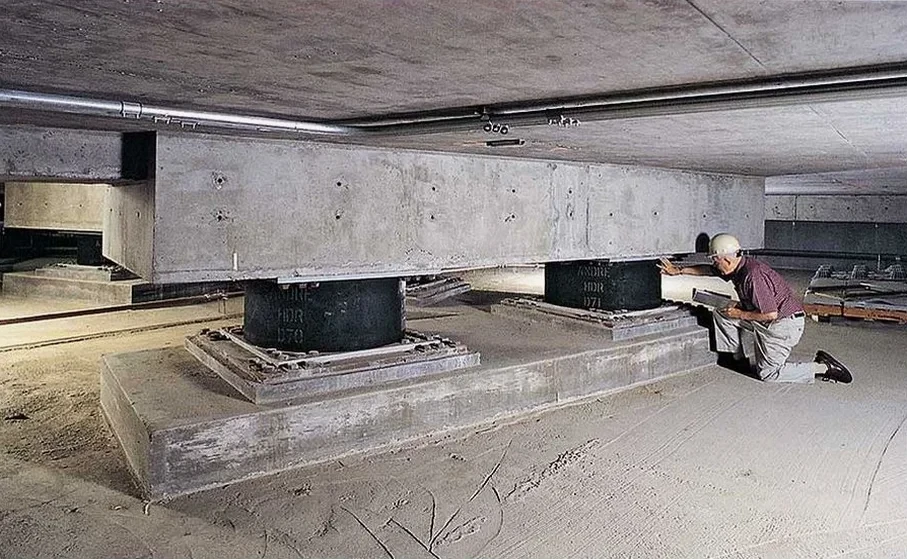
Nonlinear time-history analysis of the isolated structure, including selection of HDRB, LRB, or friction pendulum systems, and detailed design of the isolation interface and moat wall details.
Prototype Testing and Construction Oversight
Full-scale testing of isolator units per I.S. EN 15129, factory production control audits, and on-site supervision of isolator installation and grouting on the Clare limestone.
Questions and answers
What is the typical cost range for base isolation seismic design on a project in Ennis?
Base isolation seismic design for a building project in County Clare typically falls between €3,570 and €8,680, depending on the complexity of the structure, the number of isolators, and the extent of the site-specific ground investigation required. A straightforward low-rise building on competent limestone will sit at the lower end, while a larger irregular structure needing extensive nonlinear analysis and prototype testing will push toward the upper end of that range.
Is base isolation really necessary for a building in Ireland given the low seismicity?
The decision comes down to the consequences of downtime rather than just the probability of collapse. In Ennis, critical facilities like hospitals and emergency centres cannot afford to be non-operational after even a moderate event, and base isolation keeps drift low enough that operations remain online. The stiff limestone geology in Clare can amplify certain ground motions, so a conventional fixed-base design may still suffer costly non-structural damage in an event with a long return period.
How do you test base isolators before they are installed on an Ennis site?
Every isolator undergoes prototype testing in accordance with I.S. EN 15129, which involves full-scale dynamic testing under design displacement and velocity conditions. We also carry out production tests on a percentage of the isolators to confirm stiffness and damping properties. For projects in the damp Irish climate, we include additional ageing and corrosion resistance checks to ensure the bearings perform consistently over the design life of the building.