The depth vibrator is the heart of the operation — a steel lance with eccentric weights spinning at up to 1800 rpm, hanging from a crawler crane that positions it over the Ennis grid. When it hits loose sand or gravelly drift, the vibrations rearrange the grain skeleton, collapsing voids and building density from the bottom up. We feed graded limestone aggregate from nearby Clare quarries into the annular space, forming a dense column that locks the surrounding ground. The process is fast, but the design behind it — vibration frequency, probe spacing, withdrawal rate — makes the difference between marginal improvement and a bearing capacity that holds. For sites near the River Fergus floodplain, where the water table sits barely two metres down, we also tie the compaction plan into the complementary in-situ permeability testing to confirm drainage paths haven't been blocked by the densification.
A well-designed vibrocompaction grid turns loose alluvium into a competent bearing stratum — but only if the probe spacing matches the soil's grain-size distribution, not a generic catalogue value.
Methodology applied in Ennis
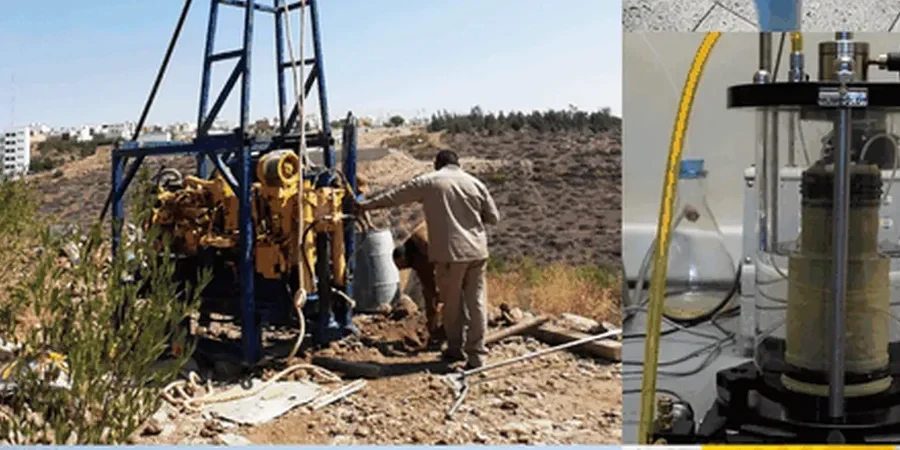
Critical ground factors in Ennis
The Shannon Estuary climate shapes how we schedule vibrocompaction around Ennis. Between October and March, sustained rainfall saturates the upper metre of soil, and running a depth vibrator through standing water creates a slurry that kills compaction efficiency — the energy dissipates in the fluid rather than rearranging grains. We either wait for a dry window with less than 5 mm of rain in 48 hours, or we pre-drain the working platform with a perimeter cut-off trench. The bigger geotechnical risk is hidden lenses of soft silt or peat within the glacial sequence; a vibrator can punch right through them without densifying anything, leaving a soft spot that shows up later as differential settlement under the slab. That's why our design always includes a pre-treatment CPT test grid at 10-metre centres to catch these pockets before the rig mobilises, and we tie the findings back to the borehole logs from the initial site investigation to avoid surprises during execution.
Our services
Our vibrocompaction scope in Ennis covers the full project cycle — from feasibility assessment through detailed design to on-site supervision and post-treatment verification. Each phase ties to the specific ground conditions we encounter across County Clare.
Feasibility assessment and soil suitability review
We analyse existing borehole logs and grain-size curves to confirm whether the deposit is compactable by depth vibration. Fines content, uniformity coefficient, and water table depth are screened against the Eurocode 7 ground model before any rig is booked.
Detailed vibrocompaction grid design
Probe spacing, vibration frequency, lift thickness, and withdrawal rate are specified based on target relative density. We carry out a signed design package with CPT acceptance criteria at grid centroids and perimeter check points.
On-site compaction supervision and QC
Our field engineer tracks each probe location by GPS, logs ammeter draw and penetration speed, and adjusts parameters in real time when ground conditions deviate from the model. Settlement plates and inclinometers protect adjacent structures.
Post-treatment verification reporting
After compaction, we execute a verification programme — CPT or SPT at 10% of treatment points — and compile a completion report demonstrating that specified acceptance criteria are met for the foundation design loads.
Questions and answers
What does vibrocompaction design cost for a typical Ennis residential or light commercial site?
For a site requiring 80 to 200 treatment points, the design package — including feasibility review, grid layout, specification, and post-treatment verification planning — typically falls between €1,520 and €4,170. The exact figure depends on site area, depth of loose ground, and the density of pre-treatment investigation data available. A smaller footprint with good existing CPT logs sits at the lower end; a larger, poorly documented site with variable alluvium pushes toward the upper range.
How do you confirm the ground has been properly compacted after the vibrator leaves site?
We run CPT soundings at a minimum of 5% to 10% of treatment points, usually at grid centroids and near boundaries where edge effects can reduce confinement. The cone resistance profile is compared against pre-treatment baselines, and we require a minimum increase — typically a doubling of tip resistance in loose sands — plus a target relative density of at least 70%. Where CPT access is tight, we use SPT or pressuremeter tests as alternatives, always referencing the acceptance criteria set during the design phase.
What's the minimum distance from existing buildings for safe vibrocompaction in Ennis?
We generally maintain 3 to 5 metres from occupied structures, but the actual setback depends on the building's foundation type, the depth of treatment, and the vibration amplitude we're running. For older masonry buildings common around Ennis town centre, we install settlement points and crack monitors before starting and run a trial probe at reduced frequency to measure peak particle velocity. If readings stay below 5 mm/s at the foundation, we proceed; if not, we either switch to a stone column approach or install a trench barrier to dampen transmission.
Can vibrocompaction handle the silty sands found along the River Fergus floodplain?
It depends on the silt content. Vibrocompaction works well when fines — particles passing the 63-micron sieve — are below 12% to 15%. Above that, pore pressure dissipates too slowly during vibration, and the soil won't densify efficiently. We always start with a grain-size analysis from borehole samples. If the silt fraction is borderline, we run a trial compaction panel on site and measure pore pressure decay with a piezometer to decide whether full-scale treatment is viable, or whether we need to move to a stone column or dynamic replacement solution instead.