The application of I.S. EN 1997-2:2007 in Ennis requires careful attention to local glacial deposits. Much of the town sits on limestone till overlying karstified Carboniferous bedrock, a combination that produces variable bearing strata within short distances. We see it regularly along the Gort Road industrial estates and in residential expansions near the Quin Road, where a soil mechanics study becomes the first line of defence against differential settlement. The River Fergus floodplain introduces soft alluvial silts into the equation, demanding triaxial testing to confirm effective stress parameters before any foundation design proceeds. Our laboratory in Ennis runs consolidated-undrained tests with pore pressure measurement, delivering the shear strength data engineers need for Eurocode 7 Design Approach 1. For larger commercial projects, we pair the soil mechanics study with deep excavation monitoring to track ground movements during construction, and a CPT test programme where the till is too dense for undisturbed sampling.
Variable limestone till over karst in Ennis means two boreholes 30 metres apart can show a 100% difference in SPT N-values.
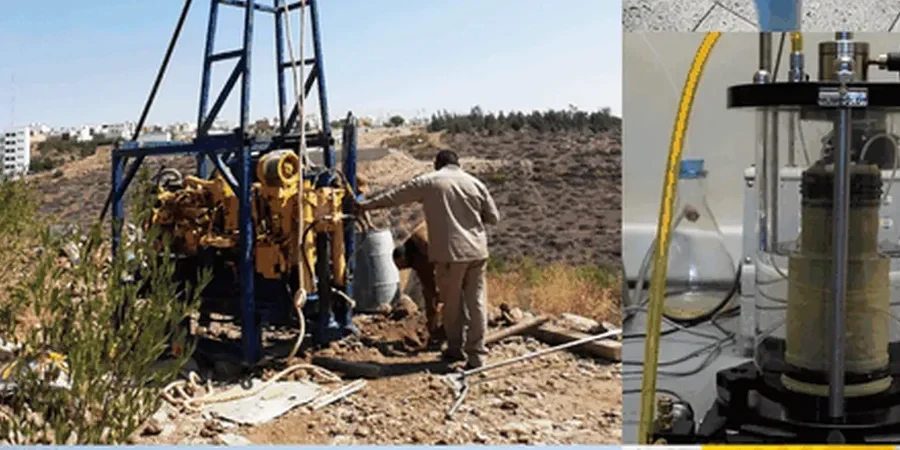
Methodology applied in Ennis
Critical ground factors in Ennis
The Atlantic moisture that defines Ennis winters accelerates chemical weathering in the limestone bedrock. Rainwater, slightly acidic from dissolved CO₂, percolates through the glacial till and enlarges fissures in the karst below. This process creates voids and soft zones that a standard borehole log might miss. A soil mechanics study that omits sulphate testing risks specifying the wrong concrete class, leading to premature degradation of buried foundations. More serious is the potential for sudden collapse of soil arches over hidden cavities, a phenomenon documented in the Clare County Council geological hazard maps. We address this risk by integrating the soil mechanics study with geophysical methods. When the lab results show high moisture content and low density in the till, we recommend a resistivity survey to map the bedrock surface and identify any air-filled voids before piling design begins.
Our services
The soil mechanics study we deliver in Ennis covers the full laboratory programme required for Design Working Life verification under the Building Regulations. We run classification, strength, and compressibility tests in our ISO 17025 accredited facility.
Laboratory Testing Programme
Moisture content, bulk density, Atterberg limits, particle size distribution by sieving and sedimentation. Effective strength parameters from isotropically consolidated undrained triaxial tests with pore pressure measurement. One-dimensional consolidation to determine Cc, Cr, mv, and cv.
Foundation Parameter Report
Interpretative report delivering design values for bearing capacity (drained and undrained), total and differential settlement estimates, and soil-structure interaction parameters. Includes specification of concrete exposure class per I.S. EN 206 based on sulphate and pH results.
Questions and answers
What laboratory tests does a soil mechanics study in Ennis typically include?
A standard programme for a residential scheme includes moisture content, Atterberg limits, particle size distribution by wet sieving, and undrained triaxial tests on cohesive samples. For commercial buildings we add oedometer consolidation tests and effective stress triaxials with pore pressure measurement. Sulphate and pH testing is standard across all projects given the limestone geology around Ennis.
How much does a soil mechanics study cost in Ennis?
The cost ranges from €3,060 to €4,950 depending on the number of boreholes, the depth of investigation, and the laboratory test schedule. A typical house site needs three classification suites and two triaxial tests; a commercial development requires consolidation and effective stress testing that increases the laboratory budget.
How long does it take to get results from a soil mechanics study in Clare?
Classification tests and triaxials on undisturbed samples take 10 to 12 working days from sample delivery. Consolidation tests add another 5 to 7 days because we need to complete incremental loading and unloading stages. We dispatch partial results for bearing capacity as soon as the triaxial data is validated.