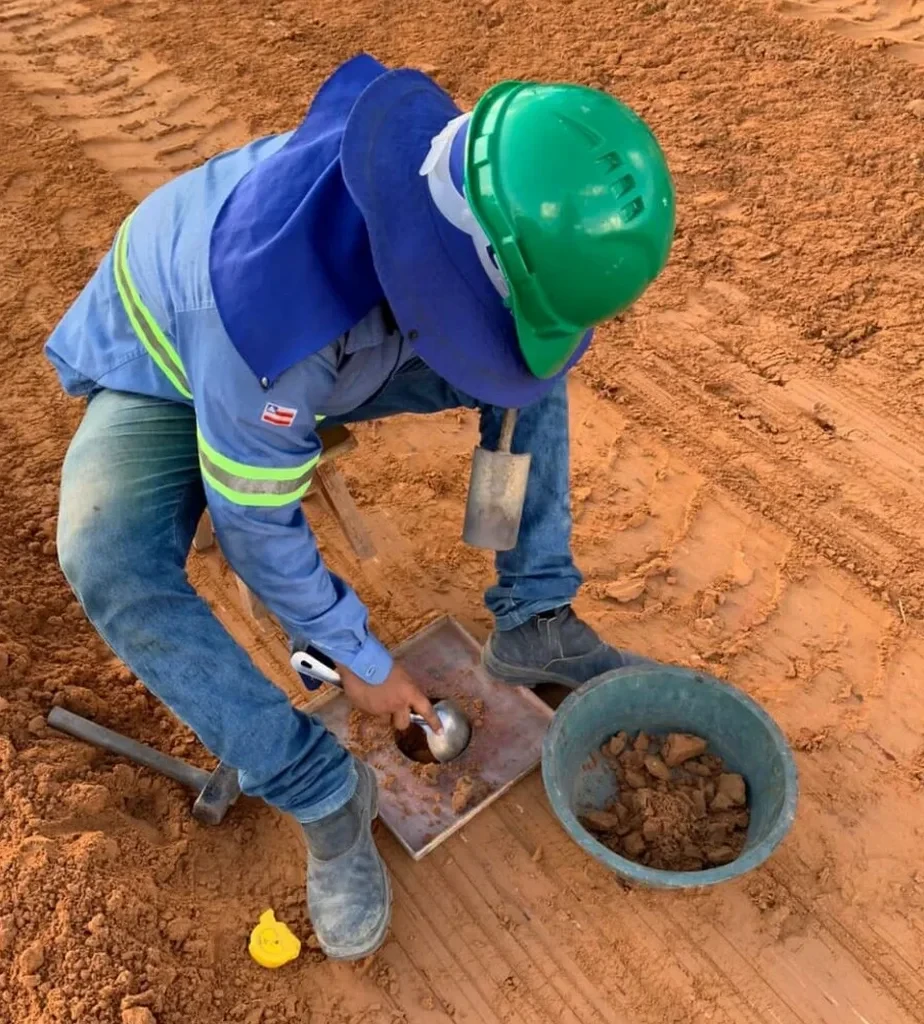
Compaction control in Ennis is governed by the Specification for Road Works and the overarching I.S. EN 1997-2:2007 (Eurocode 7 – Ground investigation and testing). When you place fill over the karstified limestone that underlies much of County Clare, achieving 95% or 98% modified Proctor density is not just a contractual checkbox — it prevents differential settlement that these variable ground conditions can trigger. We run the sand cone test (I.S. EN ISO 17892-1:2014 for the lab reference) directly on the compacted lift, comparing the in-place dry density against the laboratory maximum. The results let you sign off on road capping layers, service trenches, and building platforms with data the resident engineer accepts without pushback. For deeper profiling of the subgrade before fill placement, we often pair the compaction test with a trial pit investigation to inspect the natural ground, and when the formation level shows soft spots we recommend evaluating the CBR of the subgrade to validate the design modulus before the first load of stone arrives.
Compaction is cheap insurance — a single failed density test in Ennis can hold up a road opening for days, and the rework costs more than the entire testing programme.
Methodology applied in Ennis
Working video
Critical ground factors in Ennis
We inspected a commercial development off the Limerick Road in Ennis where the contractor had placed 600 mm of Clause 804 crushed stone without a single density test. When the consulting engineer ordered spot checks, three out of five locations failed the 95% relative compaction threshold by a wide margin — the lowest reading came back at 84%. The stone had been end-tipped and spread with a dozer, never properly rolled in thin lifts. Rework meant ripping out and recompacting half the building platform during a wet November week, with the cost of the re-testing programme alone exceeding what the original QA plan would have charged. In Ennis, the main risk is not the method — the sand cone is straightforward — but the sequencing. If you test too late, after the next lift is already down, a failed result forces you to excavate two layers instead of one. Testing immediately after compaction, with the plate and sand jar still on site, keeps the earthworks moving and the certification file complete.
Our services
Our field density service in Ennis covers the full quality control cycle for compacted fill, from the laboratory reference density through to the final site report. Each test is performed by a technician trained to the I.S. EN 1997-2 sand replacement procedure, and all equipment carries a valid calibration certificate traceable to national standards.
In-Situ Sand Cone Testing
Direct measurement of in-place density on compacted lifts using the calibrated sand replacement method. One test per 500 m² or per lift as specified by the resident engineer, with same-day reporting of dry density, moisture content, and relative compaction.
Laboratory Compaction Reference
Modified Proctor (heavy compaction) or vibrating hammer test per I.S. EN 13286-2 to establish the maximum dry density and optimum moisture content for the fill material. This is the benchmark against which all field tests are compared.
Compaction Verification Report
A consolidated QA report for the earthworks package, including test location plans, field density sheets, laboratory Proctor curves, and a compliance summary table that the local authority or funder's engineer can approve without delay.
Questions and answers
How many sand cone tests do I need on a typical Ennis site?
The Specification for Road Works generally calls for one density test per 500 m² of each compacted lift, or a minimum of three tests per lift on smaller areas. For service trenches, the standard practice is one test per 50 linear metres per lift. The exact frequency is set by the resident engineer in the site-specific quality plan, and we can advise on the most efficient layout to satisfy the spec without over-testing.
What does a field density test cost in Ennis?
A single sand cone test typically runs between €100 and €120, depending on the number of tests booked and the travel distance from our base. The price includes the calibrated sand, field equipment, technician time, and the density calculation report. For larger earthworks packages we can quote a day rate that brings the per-test cost down significantly.
Can the sand cone method be used on coarse crushed stone with 40 mm aggregate?
The standard sand replacement method works best with particles up to about 20 mm. For fill containing larger stone — such as Clause 803 or 804 with 40 mm down material — the hole volume needs to exceed about 2,800 ml to keep the error within acceptable limits. In practice, we enlarge the test hole and use a larger sand pouring cylinder. If the aggregate is consistently coarse across the site, we may recommend replacing the sand cone with a nuclear gauge (where permitted) or a plate load test to verify the stiffness directly.