The old core of Ennis grew around the River Fergus, and centuries of building on soft alluvial silts have left their mark on the town’s foundation conditions. Narrow medieval lanes and modern housing estates share the same challenge: any change in grade needs a wall that actually works with the ground, not against it. On recent projects near the Gort Road industrial area, we’ve seen groundwater appear at less than 1.5 metres, which changes the entire lateral load picture. Before finalising a retaining wall design, the critical step is understanding what lies beneath the surface. In many Ennis jobs we combine the wall analysis with test pits to inspect shallow bearing strata directly, or specify CPT testing where the profile is deep and variable, ensuring the wall’s base sits on competent material and the drainage design handles real site moisture.
A retaining wall in Ennis is only as reliable as the ground data behind it – guess the water table and you’ve already lost the wall.
Methodology applied in Ennis
Critical ground factors in Ennis
The damp Clare climate isn’t just a conversation starter – it directly affects how a retaining wall performs over time. Ennis gets around 1,100 mm of rain annually, and the saturated winter ground can double the lateral thrust on a wall if the drainage isn’t working. We’ve inspected walls in the county where the backfill had turned to slurry, and the only thing holding the structure was luck. When the retained material is a silty clay typical of the Fergus basin, pore pressure build-up during prolonged wet spells becomes the dominant load case. Our designs always include a solid drainage layer, filter fabric to prevent fines migration, and outlets spaced to handle the local rainfall intensity. In sloping sites, we also run a global stability check because a wall can be perfectly strong and still slide as part of a larger rotational failure if the underlying stratum is weak.
Our services
Our Ennis work covers the full retaining wall design cycle, from initial ground investigation to construction-ready drawings. The two core operations below are tailored to the scale of the project and the complexity of the site.
Cantilever and gravity wall design
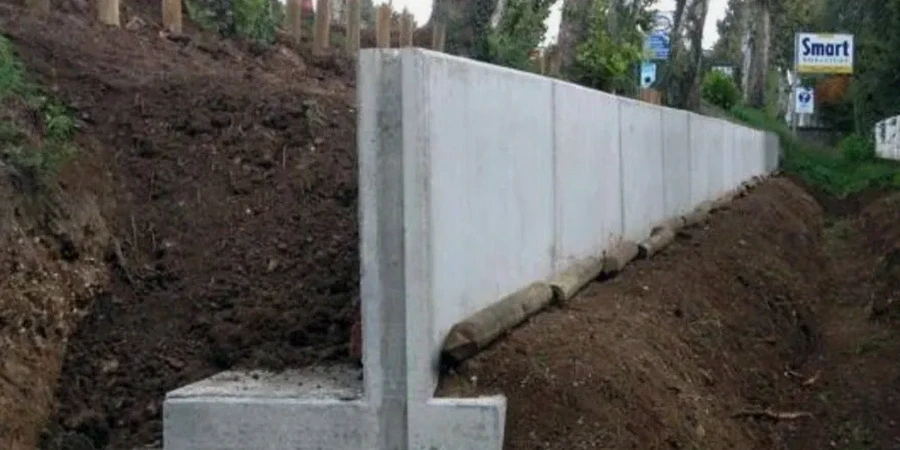
For residential and light commercial sites where retained heights are typically under 3 metres. Includes geotechnical parameter selection, bearing capacity and sliding checks, reinforced concrete detailing, and drainage specification. We coordinate with the local structural engineer and carry out drawings suitable for planning submission.
Deep excavation support and anchored walls
For basement excavations and infrastructure cuts in tight Ennis town-centre sites. We design sheet pile or soldier pile walls with tie-back anchors where space is limited. The analysis covers staged excavation, strut pre-load, and groundwater control, with monitoring trigger values defined before construction starts.
Questions and answers
How much does a retaining wall design for an Ennis site cost?
The design fee ranges from €1,070 to €3,300, depending on wall height, ground complexity, and whether additional investigation like boreholes or test pits is needed. A straightforward cantilever wall on a greenfield site sits at the lower end; a tied-back wall in a congested urban plot with poor ground falls towards the upper end. We give a fixed-price proposal after reviewing the site plan and any existing soil data.
What is the most common retaining wall failure you see in County Clare?
Poor drainage is the number one problem. Water builds up behind the wall, increases the pressure, and eventually pushes it forward or cracks the stem. In Ennis, where winter rainfall is heavy and the Fergus floodplain soils hold water, a properly graded granular backfill and working weep holes make the difference between a wall that lasts decades and one that tilts within five years.
Do I need planning permission for a retaining wall in Ennis?
Walls over 1 metre high that are near a public road or boundary generally require planning permission under Clare County Council rules. Even if permitted development applies, the council may ask for a design certificate from a chartered engineer. We prepare the geotechnical design report and drawings that planning departments expect, referencing the relevant Eurocode design checks.