The karstified limestone under Ennis doesn't forgive shallow assumptions. The River Fergus floodplain deposits —soft silts and organic clays draped over pinnacled bedrock— mean a conventional strip footing can punch through without warning. We approach pile foundation design here as a problem of variable bearing strata, not just load transfer. Core data from the Geological Survey of Ireland confirms the Ennis basin sits on Dinantian pure bedded limestone, with overburden depths swinging from 2 to 18 metres across a single site. That range demands a deep foundation logic built on site-specific investigation, not generic assumptions. Before sizing the pile group we typically run a CPT test to map the soft-to-firm transition and pinpoint the rockhead profile, then refine the shaft friction estimate with lab-stage triaxial testing on undisturbed samples extracted from the bearing layer.
Pile design in Ennis is a rockhead puzzle: two boreholes five metres apart can show six metres of elevation difference on the limestone surface.
Methodology applied in Ennis
Working video
Critical ground factors in Ennis
I.S. EN 1997-1:2005 with the Irish National Annex mandates a Design Approach 1 for persistent/transient situations — which means both partial factor sets (DA1-1 and DA1-2) must be satisfied. In Ennis this creates a specific pinch point: the soft alluvial clays deliver low undrained shear strength (frequently 18–30 kPa in the upper 5 metres), so the structural load case must simultaneously consider geotechnical ultimate limit state under the lower-bound friction angle and structural serviceability under the upper-bound settlement profile. The karst introduces an additional hazard: an open cavity or a clay-filled fissure bypassed by a single investigation point can invalidate the pile group stiffness assumption. We therefore require a minimum of three investigation locations per foundation footprint and always cross-check the pile foundation design with a seismic refraction survey to flag velocity anomalies indicative of voids or highly fractured zones before finalising pile positions.
Our services
Every pile foundation design we deliver in Ennis starts from a ground model, not a structural drawing. The four service stages below map directly to the geology of the Fergus basin.
Geotechnical Desk Study & Ground Model
Review of GSI borehole records, karst feature databases, and historical flood mapping for the Ennis urban area to build a preliminary ground model before any rig arrives.
Site Investigation & Parameter Selection
CPT soundings, rotary cored boreholes with SPT sampling, and laboratory triaxial/oeodometer testing to derive characteristic values for the alluvium and the limestone bedrock.
Pile Design & Load-Settlement Analysis
Full ULS and SLS calculations under DA1-1/DA1-2, including group effects, negative skin friction estimation where organic clays are present, and rock socket shear capacity verification.
Construction Monitoring & Pile Integrity Testing
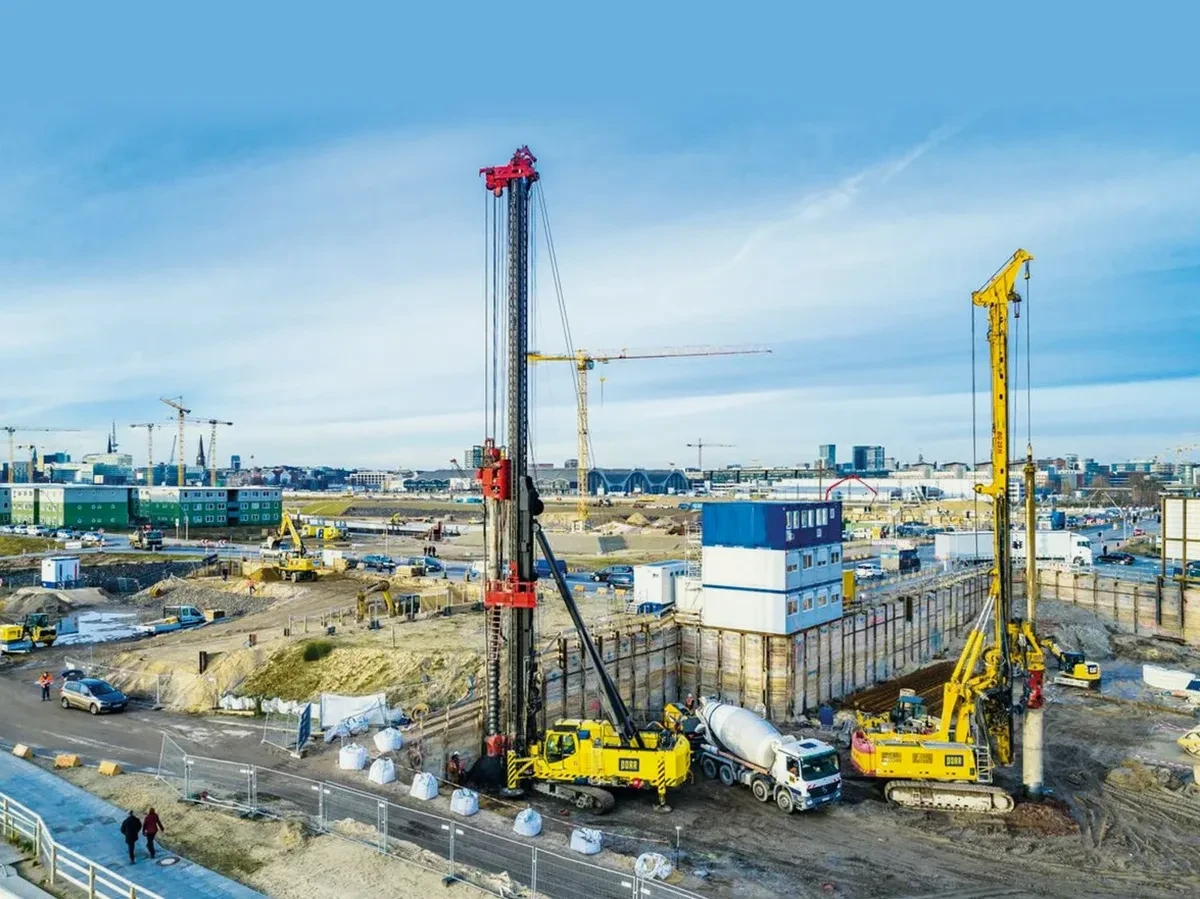
On-site supervision of CFA installation, MWD data review, and post-construction low-strain integrity testing (PIT) or cross-hole sonic logging on selected piles.
Questions and answers
What does pile foundation design cost for a typical house extension in Ennis?
For a single-storey extension on the Ennis alluvium requiring four to six CFA piles with a design package, the range usually sits between €1.740 and €5.590. The spread reflects whether the site needs a full CPT campaign and laboratory triaxial testing, or whether adequate GI data already exists. A desktop study-only package falls at the lower end; a turnkey design with construction-phase monitoring sits at the upper end.
How do you deal with the karst limestone under Ennis?
The karst requires a two-stage approach. First, we map the rockhead variability with CPT and seismic refraction to identify possible cavities or soft zones. Second, we design the rock socket length conservatively — typically 1.5 to 3 times the pile diameter — and specify temporary casing through the overburden to prevent concrete loss into open fissures. If the geophysical survey flags a large void, we adjust pile positions to avoid it rather than attempting to bridge it.
Which Eurocode parts govern deep foundation design in Ireland?
The primary standard is I.S. EN 1997-1:2005 (Geotechnical design) with the Irish National Annex, which mandates Design Approach 1 for persistent design situations. This means we must run both partial factor sets — DA1-1 and DA1-2 — and take the more conservative result. I.S. EN 1992-1-1 governs the structural concrete design of the pile shaft, and I.S. EN 1536 covers execution of bored piles including CFA. The Irish Annex introduces specific provisions for rock socket design in karst terrain that differ from the generic Eurocode recommendations.