Deep excavation design in Ennis must address a subsurface profile that shifts sharply over short distances. The eastern side of town sits on well-drained limestone bedrock close to the surface, while the Fergus floodplain and areas near the town centre carry up to six metres of soft alluvial silt and organic clay. IS EN 1997-1:2005 (Eurocode 7) requires a design that explicitly accounts for these transitions, particularly where DA2* partial factors interact with low undrained shear strength. The permanent groundwater table—often within two metres of ground level in winter—adds hydraulic uplift risk that changes the shoring demand. For sites within the medieval street grid, where adjacent three-storey masonry shares party walls, a retaining walls analysis that couples wall deflection with ground loss is not optional; it is the basis for protecting third-party structures. On larger greenfield plots west of the N85, base heave becomes the controlling limit state, and we regularly pair the excavation design with slope stability checks for temporary batter cuts through the glacial till.
Base stability in Ennis glacial till is governed by pore pressure in silt partings—not just the bulk undrained shear strength.
Methodology applied in Ennis
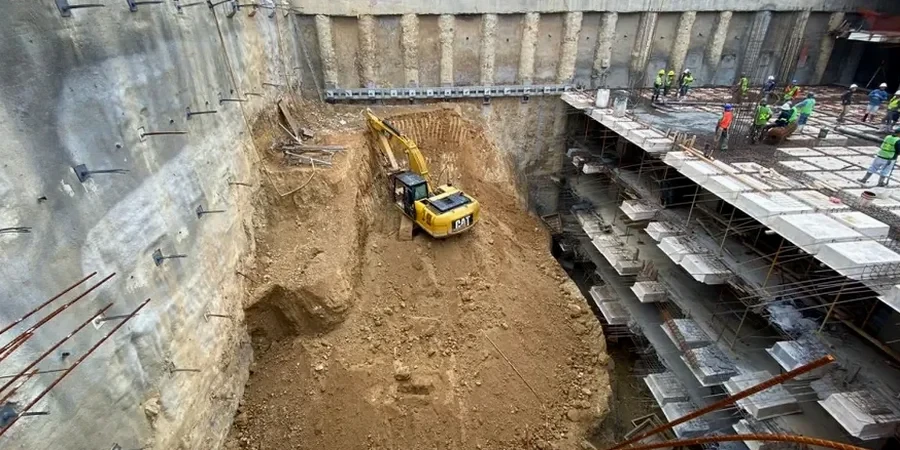
Critical ground factors in Ennis
A hydraulic crawler rig drilling through Ennis glacial till hits the limestone bedrock interface abruptly—often within a single 1.5-metre run. That transition is where excavation risk concentrates. If the till-limestone contact is weathered and clay-filled, a sheet pile toe that looked adequate in the desktop model will refuse early or, worse, will drive into a dissolution void and lose passive resistance overnight. The drilling crew on site reports every change in penetration rate and flush return colour; the design engineer adjusts the toe level in real time. In the town centre, vibration monitoring on neighbouring Georgian and Victorian buildings runs continuously during piling, with trigger thresholds set at 3 mm/s PPV. A sudden spike in vibration or a 2 mm settlement reading on a crack gauge can halt the works and force a switch from vibratory to oscillated installation—or a redesign to a lower-impact secant wall with stitch drilling.
Our services
The deep excavation design package delivered for Ennis sites covers the full chain from ground characterization to construction sequencing. Every output is calibrated to the Clare subsurface and the local regulatory environment.
Shoring and Retaining Wall Design
Full ULS and SLS design of embedded retaining walls per Eurocode 7, including DA2* load cases, prop and anchor stiffness modelling, and wall deflection analysis. Deliverables include wall schedules, anchorage details, and staged excavation drawings with groundwater control notes specific to Ennis alluvial and till conditions.
Base Stability and Groundwater Control
Assessment of hydraulic heave, piping, and base uplift for cuts extending below the Fergus floodplain water table. Design of dewatering and recharge systems where drawdown outside the excavation would affect timber-piled foundations in the town centre conservation area.
Questions and answers
What is the typical cost of a deep excavation design for a basement in Ennis?
The design fee for a single-level basement excavation in Ennis typically falls between €1,970 and €7,770, depending on the retaining wall type, depth, proximity to neighbouring buildings, and the amount of ground investigation already available. A simple sheet-pile scheme with existing site investigation data sits at the lower end; a secant pile or diaphragm wall design requiring supplementary rotary coring through glacial till, piezometer installation, and a full SLS deflection analysis will move toward the upper end.
How does the Ennis ground investigation affect the excavation design?
The ground investigation directly dictates the shoring type and the construction method. Rotary coring through the glacial till is essential to locate silt partings that trap perched water; without it, the earth pressure model is unreliable. Probing the limestone bedrock for dissolution features influences the wall toe level. The investigation programme must follow IS EN 1997-2 and include laboratory triaxial testing on undisturbed till samples to define drained and undrained parameters for the DA2* analysis.
What is the main geotechnical risk for deep excavations in central Ennis?
In the town centre, the dominant risk is settlement-induced damage to adjacent masonry buildings, many of which sit on shallow strip footings or timber piles. Even a 5 mm differential settlement can open cracks in a protected structure. This risk is managed by designing stiff retaining walls with low predicted deflection, installing vibration and settlement monitoring on neighbouring properties before piling starts, and sequencing the excavation in short bays with prompt prop installation.